Performance Prep for Musicians: 5 Keys to Confidence and Clarity on Stage
A “How To” for Musicians Who Want to Feel Ready and Expressive On Stage Great performances begin long before you
O Come, O Come, Emmanuel is one of the most well-loved hymns among Christians, and is meaningful for its beautiful lyrics, but also for its haunting melody and Old World sound.
But what lies behind this cherished melody? In the opening line there is a wealth of meaning rooted firmly in the earliest Christian beliefs about Emmanuel (Jesus).
In this post, we explore the musical narrative and history within this famous hymn, and how you can bring its solemn beauty to life when performing our advanced violin and cello duet arrangement, or any other rendition.
Imagine you’re a 9th century monk, chanting in deep reverence words that have immensely deep meaning.
Ornate carvings adorn the doors and tapestry covers the walls. You take a breath and inhale the scent of incense that fills the space.
These powerful words seep into your bones as you sing in chorus with your brothers, reminding you and those listening of the promises of Almighty God.
Each verse you sing emphasizes a different and essential quality of the God you serve.
The melody, with a somber sadness, at first pains your heart. But then you remember: all the promises, promises of peace, love, joy, and everlasting life that were bought with a price.
With all these things in mind, you sing with renewed zeal.
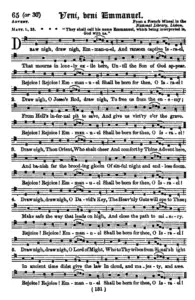
O Come, O Come Emmanuel is a deeply haunting hymn. As unusual as it is to think of any hymn of worship being described with such a dark adjective, it is nevertheless fitting.
However, the original version of the hymn we have come to know and love today didn’t always sound this way. In fact, the melody we are familiar with wasn’t even the original that went with the words!
Long before the lyrics were set to the current tune, monks in hooded cloaks were chanting these words in Latin to melodies lost to time. They may not have even had a notation system (way of writing notes down) at all.
Guido of Arezzo was an Italian monk who was born at the end of the 10th century. He’s credited with, if not the invention, the popularization of the musical staff.
You can imagine he was probably frustrated having to teach his fellow monks every melody by ear, so he began developing a new system. He used parts of his hand as a representation of the notes of the scale and began using staff notation to teach them to read note placements.
However, we find records of O Come, O Come Emmanuel from centuries earlier. The first lyrics that would eventually become the beloved hymn can be traced back to as early as the 8th century.
In other words, We are left to speculate what the original melody could have been, and if the standard setting is anywhere near the original mood.
Either way, the melody evokes deep emotions, so this is by no means a criticism of the hymn as it exists today.
But where did the modern melody come from?
The answer involved a series of investigations from scholars spanning nearly 100 years. ⛏️🧭 (I’m sure it wasn’t quite as exciting as Indiana Jones, but hey, musicologists need to take their thrills where they can get them!)
The current hymn is credited to John M. Neale as translator in 1851. Neale had a passion for reviving and translating ancient hymns. He loved hymns that connected you to the traditions of the past which could evoke deep reverence.
These included both Eastern and Western hymns, and he also wrote his own lyrics to be set to ancient melodies, the most famous of which is probably Good King Wenceslas.
As was mentioned earlier, music notation did not become commonplace until the 12th century, so much of the music Neale was looking for only had lyrics. Such was the case with O Come, O Come, Emmanuel.
Thomas Helmore, Neale’s friend and music editor, was the one who added the haunting melody, and, with only slight variation, it is the hymn we now know today.
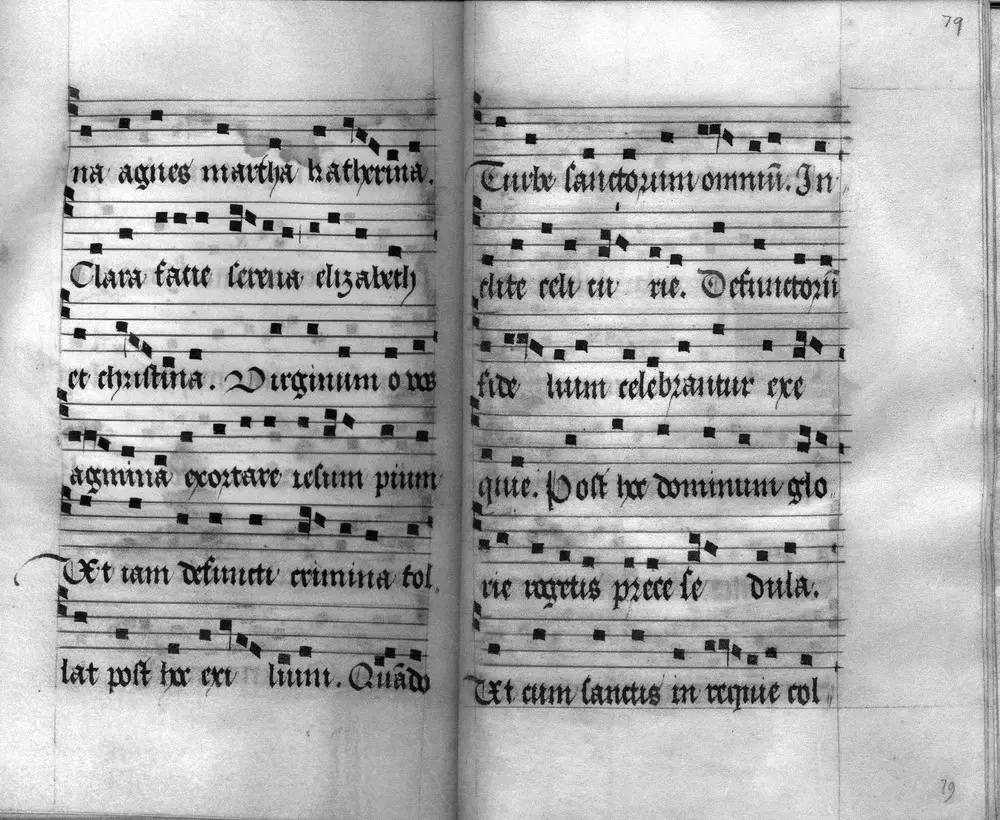
The source of Helmore’s soul-stirring tune remained a mystery. Then, in 1966, researchers discovered a manuscript in a library in France. They now knew the melody dated to the 15th century, and was part of a funeral mass. Here is an image of what was discovered:
So, this song went through many more changes than your average hymn, but boy was it worth it!
Most of us hymn lovers know of O Come, O Come, Emmanuel as a Christmas hymn. However, traditionally, it was used as part of the liturgy for the Christian season of Advent.
Advent is a time that leads up to Christmas, but there are several key differences in thinking of this hymn from an Advent perspective.
Advent celebrates the coming of Christ in all its forms:
Jesus’ first coming on earth in Bethlehem
His presences in the lives of believers through the Comforter (the Holy Spirit in the heart of every believer)
His final coming at the end of days
Some of that might remind you of the story of King Arthur as “The Once and Future King”. And you’d be right to make the connection because the story of Arthur is inspired by the story of the Christ.
So, this makes O Come, O Come Emmanuel a hymn about the past, present, and future – and you can explore and bring in a feeling of deep timelessness when playing it.
This deeper layered meaning is also about peace. Specifically, the peace that is found for the Christian who is meditating on all the ways that Jesus comes.
It’s not about bells that jingle, holly, or tinsel. It’s about eternity. That’s heavy. Which makes the minor key a good fit, which we’ll get into soon.
Although this is an excellent Christmas hymn, it is good to keep in mind the full meaning of the music, both as a listener and as a performer.
The transformation of this hymn from one used during Advent to one used during Christmas can probably be attributed to its inclusion in the Christmas section of hymn books starting in the mid-19th century.
The hymn, before that point, had largely fallen into obscurity. It is thanks to Neale and Helmore that it became a Christmas tradition – when they placed it in the Christmas section of their hymnal.
This hymn employs 3 key musical elements to convey the subdued, reverent emotions:
🎶The natural Aeolian mode
🪘Assymetry in the rhythm
🗝️Uplifting transition to the relative major
O Come, O Come Emmanuel is unusual for a Christian hymn. The fact that the music is set in minor, usually e minor, immediately sets it apart in the hymn world.
The music is in e minor, but the melody doesn’t contain the leading tone D#, amplifying the longing in the plea, “O Come, O Come…”
Each verse in minor is proceeded by the major beauty of the refrain, calling all Christians to rejoice, that despite the longing and waiting, that Emmanuel will truly come.
During the first verse, and repeated each time in the refrain, the name Emmanuel is sung, and given much more time than the other words, the syllable ‘man’ itself getting 3 beats, and drawing attention to this supremely important name.
The hymn begins in E minor, but spends most of its time in harmonies leading to G major. This creates a feeling of hope, but it always resolves back to E minor, the dark relative, not allowing the turmoil to fully resolve.
Only when the refrain comes do the clouds break and the sun comes out. All the darker moods melt away during the powerful declaration of “Rejoice, Rejoice”.
But, even then, it’s only temporary, as it ends again in minor. This captures the feeling that the Once and Future King (Jesus) has not yet returned.
Fantasia on O Come, O Come, Emmanuel for Violin and Cello coming soon.
O Come, O Come, Emmanuel’s lyrics convey the deep meaning of the promises of God, and the music does a great job amplifying that meaning.
The minor modal harmonies provide ample scope for instrumental interpretation, and it’s a joy to explore them in an advanced professional arrangement.
Want to experience the reverence yourself? Try our violin and cello duet arrangement of O Come, O Come, Emmanuel.
O Come, O Come, Emmanuel continues to be one of the most popular Christian Christmas hymns around the world. It is rare for such an old song to continue to be sung so frequently, and that in and of itself is a testimony of its true value.
The church has undergone so many changes in the last 1000 years. From schisms to reformations, time and time again the church changes, sometimes for the better, sometimes not. The persistent love of this hymn and its adoption in all manner of worship truly sets it apart.
I guess there’s simply nothing in this hymn for anybody to argue about!
O, Come, O Come, Emmanuel has its origins in the 8th century as a liturgical chant. The melody comes from a 14th century French church service.
O Come, O Come, Emmanuel was translated into English by John M. Neale in 1851.
The hymn was originally sung in Latin, the standard liturgical language of the western church before the reformation.
There are differences in lyrics and verses simply because people, publishers, and hymn writers will adapt hymns over time. There is no unique difference for O Come, O Come, Emmanuel as compared to other hymns in this regard. Some of the wording in the translation has been updated, but the meaning is the same.
Absolutely! O Come, O Come, Emmanuel fits very well on Violin and Cello. It has relatively simple melodic motions, simple rhythms, and is in the very natural key of E minor. Also, the melody and bass lines are both uniquely interesting, offering a very pleasing counterpoint throughout the music.
There are many ways to play this music, and we have two different arrangement available. One is a simpler duet, catered to late beginner and early intermediate players, and the other arrangement is for professional advanced violinists and cellists.
A “How To” for Musicians Who Want to Feel Ready and Expressive On Stage Great performances begin long before you

The Struggle: Why Note Reading and Sight-Reading Are So Hard for Violin, Viola, and Cello Students The ability to read