Performance Prep for Musicians: 5 Keys to Confidence and Clarity on Stage
A “How To” for Musicians Who Want to Feel Ready and Expressive On Stage Great performances begin long before you


The ability to read music is a vital skill for musicians, but teaching it to violin, viola, and cello students comes with many challenges and pitfalls.
Firstly, having strong note-reading skills along with ear training is one of the best ways to help students learn their music with as much ease as possible, because if the student is weak in either area, it can cause a lot of frustration.
Some students plod along note-by-note, making it nigh on impossible for them to remember what they are attempting to learn.
The phrase “in one ear and out the other” comes to mind. The process, if too challenging, can make repertoire feel a lot harder than it actually is, stunting progress unnecessarily.
On the other hand, there’s the student that doesn’t take the time needed to read their music carefully because it feels like hard work.
This student will get confused over varying finger patterns across strings, miss important key changes, accidentals, rhythms, etc… only to learn something quite different than what the teacher assigns!
However, in order to grow the skill of sight-reading so learning music can remain joyful and fun, it has to be a regular part of practice, which comes with its own problems.
Sight-reading a lot can cause all sorts of technical troubles even for students at an intermediate level (hand frame, bow straightness, bow hold, and more). It can be a minefield for bad habit development!
That’s a high cost because it is much easier to learn something correctly from the beginning than having to break the bad habits once they take hold!

So, what’s the best solution for the problems stated above? How can we help our students get through what feels like the drudgery of note-reading and foundational technique to keep their enthusiasm for music alive and thriving?
Because the preface of the Wohlfahrt Sixty Studies says it pretty well:
“The study of the violin presents certain difficulties for beginners which are frequently the cause of a sudden abatement in the pupil’s zeal and ambition, even before he has mastered the first rudiments.”
In other words: This is a very fragile time, and that is equally true for violists and cellists.
Over the years, we’ve tried a variety of books to overcome these problems and help students learn to read alongside learning their other foundational skills.
The most common issues we faced with these methods:
 lack of interest for the student (the simple music or method wasn’t engaging)
 the students would learn notes but forget them as the book went on to focus on new notes on new strings
 if they read enough new music to help them develop strong note reading, it can distract them from other technique, leading to poor posture
 The anxiety caused by sight-reading can lead to excessive tension in hands and shoulders
 If you take the process slower to avoid bad habits, the method can’t keep up with their music learning needs
 limited music theory is covered
Additionally, it is proven that learning to sight-read with an instrument in hand isn’t the most effective method to develop strong sight-reading skills! *Science shows that practicing note reading away from your instrument can actually improve sight-reading fluency. By separating reading skills from playing, students strengthen their ability to recognize patterns quickly, and later apply them with more confidence at their instrument.
Learning note-reading and understanding of music away from the instrument is really useful for student string players, so they can transition to higher positions and new fingerings more easily (when all of a sudden all the finger patterns need to be reworked).
*The principle of reduced cognitive load (from Cognitive Load Theory, Sweller, 1988)
How Theory Quest™ Helps Violin, Viola, and Cello Students Read Music Faster
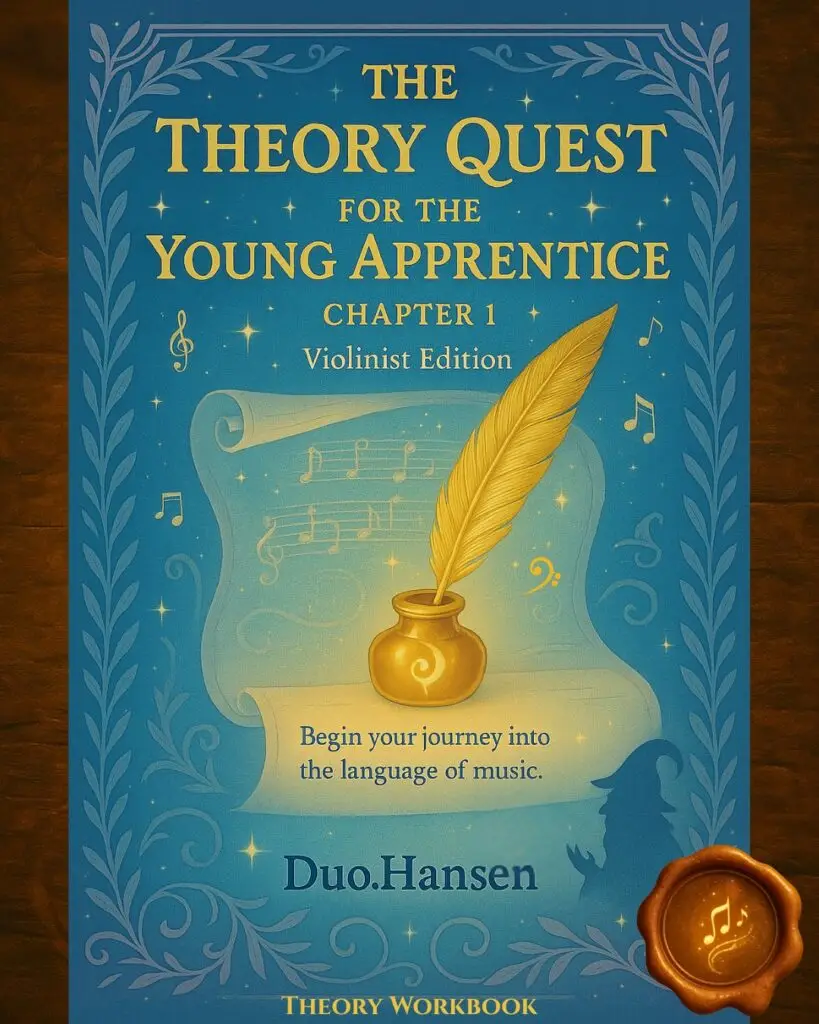
As musicians who have a passion for teaching violin/viola, cello, and composition/theory, we wanted to use our experience to create a solution for ourselves and for teachers and students looking for a better way.
To solve the problems our students were facing, we turned to a self made mixture of books, methods, and handwritten exercises… including some designed for piano that had to be amended for better string application. It worked much better and students who had regularly struggled with note reading were learning and absorbing much quicker.
But, it was still pretty dry, especially for young students.
That was how Theory Quest™ was born. By taking the approaches that worked fastest (using the Cognitive Load Theory) and combining it with story telling, characters, and challenges – for a story-driven experience with game-like activities, we created a fun engaging system that brought kids into a world of note reading and music theory that feels like being part of an adventure.
Both of these aspects have been proven to accelerate learning!
And because these are all practiced away from their instrument, they build rock solid note recognition and theory understanding without jeopardizing their foundational skills early on. That’s a win-win!

 String-Centered — Editions designed specifically for violin, viola, and cello students so concepts connect directly to the instrument.
 Story-Based Learning — Characters, lore, and adventures keep students engaged beyond worksheets.
 Quest-Like Challenges — Each activity feels like a step in an adventure, making theory practice rewarding.
 Fun & Fluency — Balances playfulness with mastery, helping students build lasting fluency in music theory.
 Printable & Reusable — Sheets can be reprinted for extra practice to build fluency faster.
 Connected to Duo.Hansen’s Musical Realm — Expands into lore, maps, and hidden Easter eggs across other resources.
 Progression Built In — Levels are tied to the Scorekeeper’s Seals, so students can track advancement like a game.
 Imaginative Gateway — Appeals to creative students who love stories, fantasy, or roleplay, blending practice with adventure.
 Teacher-Friendly — Easy to integrate into lessons with clear objectives while still feeling magical for students.
 Bridges Theory & Performance — Activities reinforce skills students immediately apply in their repertoire.

Because Theory Quest™ is designed to be practiced away from the student’s instrument, this method can be done alongside any repertoire/technical method to enrich the student’s musical education.
It’s not designed to be played on the instrument, so a student can be challenged at a higher level with overall staff mastery, theory concepts, and fingerboard understanding long before needing to play them. This gives a great edge to the student as they progress into actually using these skills.
And because the student begins learning the staff and fingerboard in a musically holistic way, it allows them to recognize the true patterns that exist and avoid misunderstandings that are hard to overcome down the road.
This is because learning small snapshots of patterns and notes can be confusing. For example, a common misunderstanding on violin: low 2nd fingers are naturals or low 1st fingers are flat. Students working through Theory Quest™ will master the musical language, so they can thrive as instrumentalists.
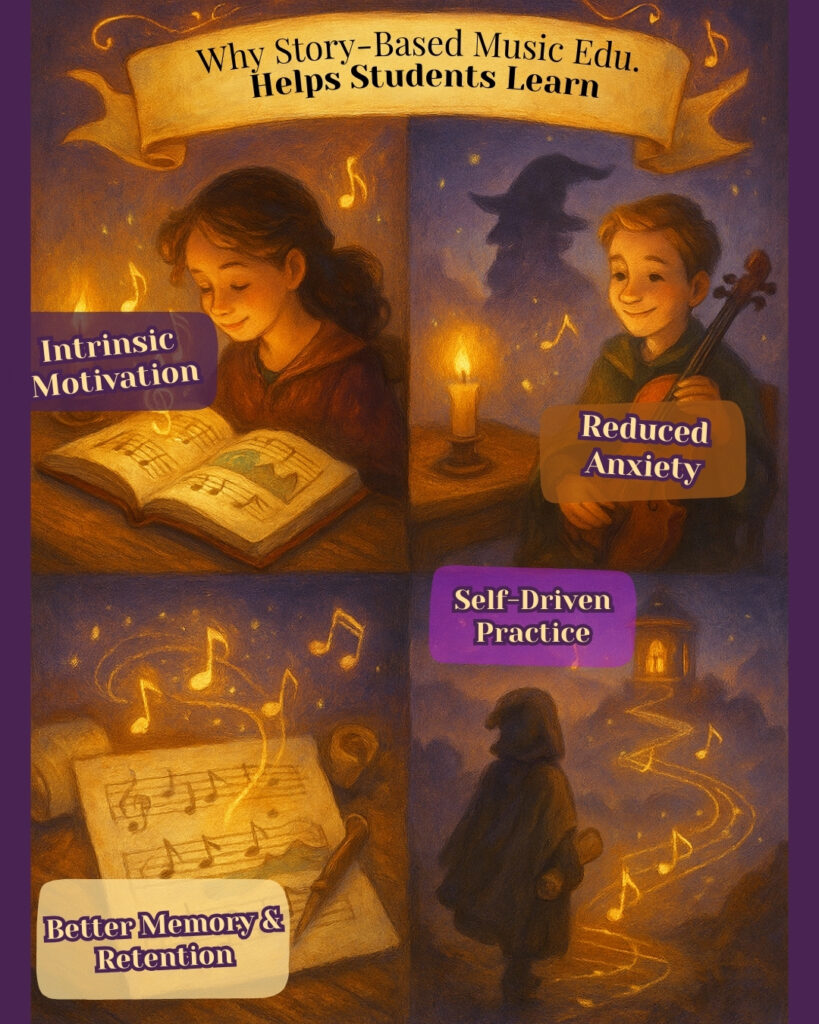
The elements that make Theory QuestTM so engaging for students are backed by real scientific research. When narrative stories, characters, and challenges that feel like quests are added, fun is the natural result. And when students are having fun while they learn, the results are pretty remarkable.
Researchers have found that when learning is placed inside a meaningful story, students are far more intrinsically motivated to stay engaged. Hidi & Renninger (2006) show that narratives spark “situational interest,” which boosts attention and persistence.
This is one of the reasons students who resist dry theory pages suddenly lean in when the same concepts appear inside a story. When that same story features the student as one of the participating characters, the results are even stronger.
Stories also help reduce the performance anxiety that often creeps in when students feel they’re being “tested.” Studies show that playful, non-evaluative environments lower anxiety and increase cognitive openness (Pekrun, 2006).
Characters like Motiverdi or Scherzini create a whimsical, low-pressure space where students feel safe exploring new material, instead of freezing up under the pressure of a test.
Another major advantage is that narratives improve memory retention. We are wired to remember stories far better than isolated facts (Schank & Abelson, 1995). When notes, intervals, or rhythm concepts appear within an adventure rather than a bland workbook, they stick.
Instead of memorization by rote, students learn because the material was connected to a real contextual moment inside the world of Theory Quest™.
And perhaps one of the most powerful outcomes is this: Kids return to story-based learning voluntarily. After all, what’s a more important fundamental concept in any person’s development than self sufficiency? When a student begins to show curiosity, creativity, and a drive to pursue a task all on their own, they are well on their way to high achievement.
When learning feels like an adventure rather than a chore, students come back to it on their own (Malone & Lepper, 1987). No nagging or reminding needed!
A narrative creates emotional connection, which is always something the brain relies on to deepen learning and form long-term memory pathways (Immordino-Yang & Damasio, 2007).
When strong pedagogy and imaginative design meet, students learn better and enjoy the process more. By combining research-backed targeted skill building with a world of characters, stories, and quests, Theory Quest™ gives young string players the structure they need with the flair and adventure they crave.
Our goal is simple: make the foundations of music feel accessible and exciting. With resources that respect both the science of learning and the spirit of play, students discover the mysterious language of music theory and do it with joy.
Check in on our Instagram to see what this month’s challenge is. Join in and share your journey with the hashtag #DuoHansenPracticePath so we can cheer you on. The community will help you stay on track and have fun in the process.
 Visit the Store to download tools, explore bundles, and join our musical world.
You’ll find tips, sheet music, and a growing community of players who have joined the Quest to #PlayTheLegend.
How long should I practice each day?
This depends largely on your level, age, and goals. But there’s one universal truth: always, and we repeat, always get that violin, viola, or cello (or whatever instrument you call your own) out of that case on the hard days.
Even if it’s only for 5 minutes before bed. Even if it’s only a silent finger drill.
Do. It.
Otherwise, talk to your teacher about how much to practice daily – it might be 30 minutes or 4 hours. They’ll know best.
What if I miss a day?
No guilt needed. Just begin again tomorrow. Your progress and journey are not about any single day, but the patterns you create. If you zoom out and look at your month and see a high number of missed days, take steps to correct it. But one day in a blue moon won’t set you back. You got this. Keep your eyes on today.
Are the Scorekeeper’s Sheets free?
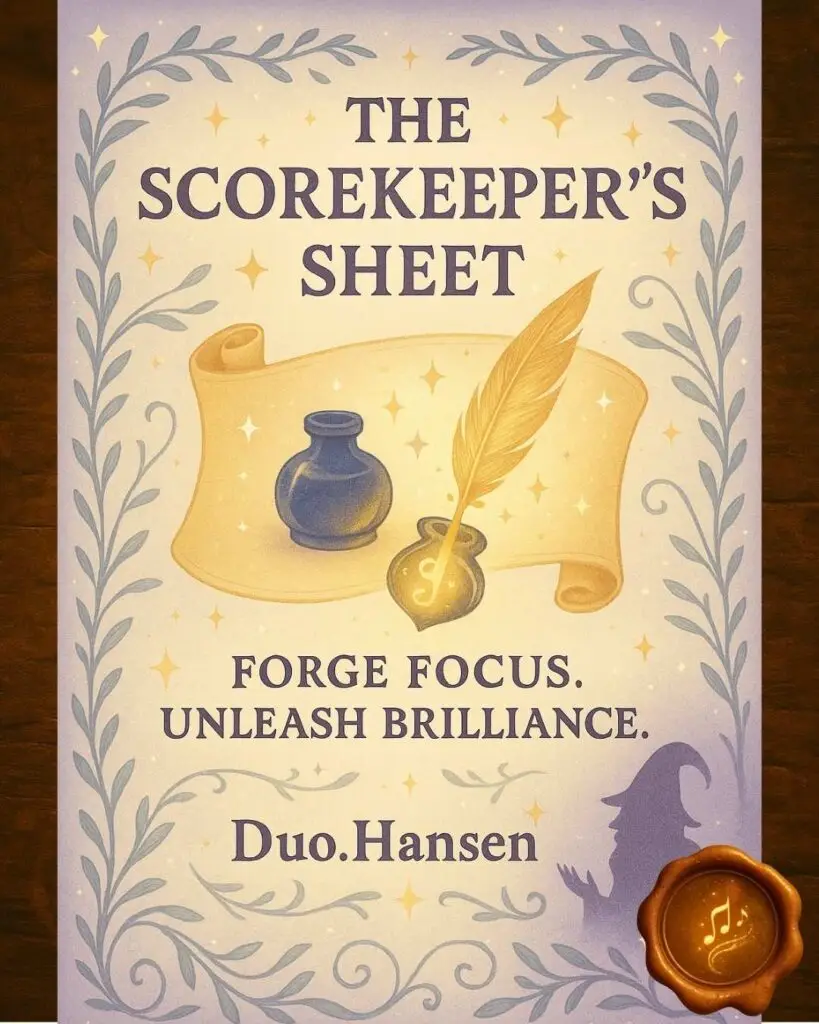
One complimentary beginner/intermediate sheet comes with a purchase of a beginner and intermediate bundles (bundles bearing an amber or green seal). The full collection for the beginner/intermediate and our Focused Practice Edition for upper intermediate/advanced are available in our shop.
Do I need to play violin or cello to use these tips?
Not at all! While we specialize in string playing and practice, our practice strategies are tried, true, and traditional – and will work for any musician.
Start Your Most Consistent Practice Month Yet Your practice journey doesn’t have to feel like a lonely uphill battle. With just a few steady shifts – you can transform your practice from scattered effort to meaningful momentum.
Together, let’s make your practice routine stick. 
A “How To” for Musicians Who Want to Feel Ready and Expressive On Stage Great performances begin long before you
Finding Your Best Sound: Expert String Care Advice for Violinists, Violists, and Cellists If you take your string playing